One night in 1821, in the Nebraska panhandle a meteor left a red streak across the sky. A few days later, an Oglala Sioux woman named Walks-As-She-Thinks, gave birth to a boy. The boy was named Red Cloud. He became a great warrior and political leader who spent his life changing tactics to protect his cultural heritage while adapting to a changing world.
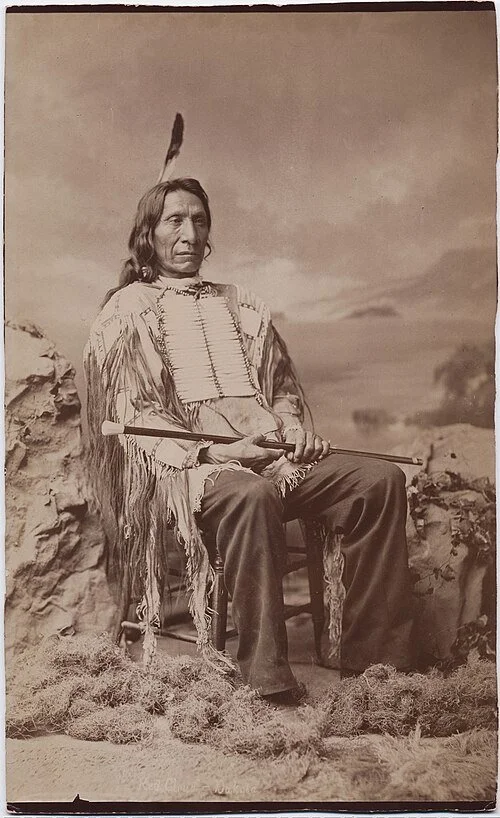
Red Cloud
Red Cloud was about four years old when his father died of alcoholism. Alcohol was pushed on Indians by American and Canadian traders much like modern drug dealers push their contraband. The “water that makes men crazy” allowed white traders to create lopsided trade deals with drunken tribal members, while governments looked the other way. (Alcohol and illicit drugs remain the scourge of Indian Country.)
After his father’s death, Red Cloud and his mother joined an Oglala band led by Old Smoke, who was most likely his mother’s brother. Old Smoke raised Red Cloud, but a fatherless child in patriarchal Sioux society had very low social status. Red Cloud overcame his low social status by becoming the best at everything; the best hunter, rider, and fighter.
Red Cloud was about sixteen years old when he joined a raiding party and made his first kill, a Pawnee warrior. By the 1840’s, Red Cloud’s natural leadership inspired others to follow him, particularly after he developed new fighting tactics. He reduced the size of raiding parties to as few as ten warriors because they moved more quickly and stealthily and it meant more warriors remained in camp to protect their families.
During one raid his warriors recovered Sioux horses stolen by the Crow and repaid the Crow by stealing their horses. While a few warriors escorted the horses back to camp, Red Cloud and the others laid false trails that spooked their enemy into expecting an ambush. The final humiliation for the Crow was looking up at a ridgeline to see Red Cloud’s raiding party mooning them.
Many tribal members believed he had supernatural powers because he was never seriously injured in battle. Red Cloud’s tactics were so successful that warriors from other Sioux bands asked to join him.
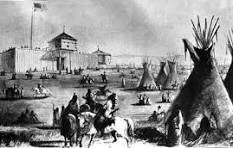
Fort Laramie
But their traditional nomadic life of hunting and raiding enemies was under pressure as white settlers spread westward. Many tribes protested the invasion that ruined their hunting grounds and brought deadly diseases like measles and cholera. Their complaints were ignored by Indian agents at Ft. Laramie, Wyoming Territory. The Indian agents connived with the military to induce “Laramie Loafers”, Indians dependent on white trade goods and alcohol, to sign “treaties” that were then forced on the protesting tribes. Conflict was inevitable.
On August 19, 1854, a hungry Indian shot a skinny cow owned by settlers staying near Ft. Laramie. The Indians offered restitution, in accordance with their customs, which should have resolved the matter. But a drunkard named 2nd Lt. John Grattan refused the restitution, loaded up a couple of cannons and marched out to the Indian encampment. As tribal headmen approached, a soldier fired a shot killing one of them.
All hell broke loose. When the smoke cleared away, Grattan and all his troopers were dead. White newspapers falsely claimed the Indians fired first in a 19th century example of alternative facts. Grattan’s superiors kept silent to protect their careers; and white traders stayed mum to keep their government contracts to sell substandard goods to the Indians.
The Grattan Massacre (when the Indians won, it was a massacre; when whites won, it was a battle) illustrates a key policy failure of the U.S. government. Western forts were a dumping ground for incompetent failures. The officer corps consisted of angry, hard drinking idiots full of self-pity at their “demotion” and a belief in their racial superiority. That caused them to consistently underestimate their opponent over the next thirty years of constant war.
Following the Grattan Massacre, Red Cloud recognized that the tribes needed to work together to have any chance of winning. He was already attracting Sioux, Cheyenne, and Arapaho warriors who were willing to try his new tactic of simultaneously hitting small targets with overwhelming superiority. He tested his new tactics against troops from Ft. Bridge Station.
The fort was built to protect traffic on the Bozeman Trail, which sliced through the Powder River Valley, Red Cloud’s favorite hunting grounds. Wagon trains with settlers and freight wagons of supplies for the fort were constantly attacked. To stop the attacks, in July 1865, troops from Ft. Bridge Station sallied forth to teach the Indians a lesson.
In the first phase of the fight, Lt. Caspar Collins commanded 28 troopers who were to escort freight wagons. After they crossed the river and went beyond the firing range of the fort, they were attacked from two sides. A few soldiers tried to gallop back to the fort and ran headlong into Red Cloud’s hand-picked warriors who were concealed along the riverbank.
Thirty minutes into the fight, the second phase began when Cheyenne Dog Soldiers were sent to attack the freight wagons. Four hours later when Red Cloud called off the attack, all the freighters and most of the soldiers were dead. (Ft. Bridge Station was renamed Ft. Caspar; present-day Caspar, Wyoming.)
Bridge Station was the first example of the Indians hitting two targets simultaneously with overwhelming superiority. The Indians had also suffered high losses due to inexperience with Red Cloud’s new tactics. But they adapted quickly to the new tactics to isolate and destroy the enemy.
They perfected their new tactics on December 21, 1866, outside of Ft. Phil Kearny. The battle started when Lt. William J. Fetterman, another drunken, arrogant officer with delusions of racial superiority, led a column of 53 soldiers to save a wood cutting party. They never reached the woodcutters. Instead, they were lured into attacking a handful of warriors led by Crazy Horse who retreated to a pre-arranged spot where 2,000 warriors attacked the soldiers from all sides.
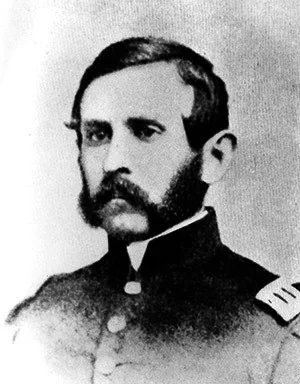
William J. Fetterman
A relief column of 27 soldiers and civilians was also wiped out. A third relief column approached Fetterman’s position but lacked the numbers to attack and could only watch the Indians scalp and mutilate the dead and dying. Mutilation before and after death was a terror tactic used by Indians and whites. The entire battle lasted about 40 minutes and wiped out half the fighting force of Ft. Phil Kearny. The details were so ghastly that the official Army report was suppressed for 20 years.
The Fetterman Massacre was the biggest defeat of the U.S. by an Indian force, until Custer met fame and misfortune at the Little Big Horn River in 1876. Red Cloud’s War to close the Bozeman Trail dragged on for another year and half until a peace commission arrived at Ft. Laramie and agreed to close the forts and the Bozeman Trail. As the soldiers marched away, Red Cloud sent warriors to burn the forts. He is recognized today as the only Indian leader to win his war against the U.S.
Red Cloud eventually realized that fighting a growing tide of white settlers in a war of attrition would end poorly for the Indians. He changed tactics again and negotiated a transition to reservation life. During this final phase of his life, Red Cloud used his political skills to balance partial assimilation while preserving as much of Sioux culture as possible. He remained a leader of the Oglala until his death in 1909 on the Pine Ridge Reservation in South Dakota.
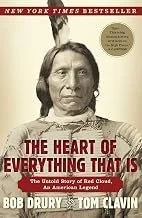
This account of Red Cloud is taken from The Heart of Everything That Is: The Untold Story of Red Cloud, An American Legend, Bob Drury and Tom Clavin (2013)
If you would like Norma’s blog sent to your inbox, we invite you sign up by clicking here! And we will see you next time!
And be sure to follow Norma on LinkedIn